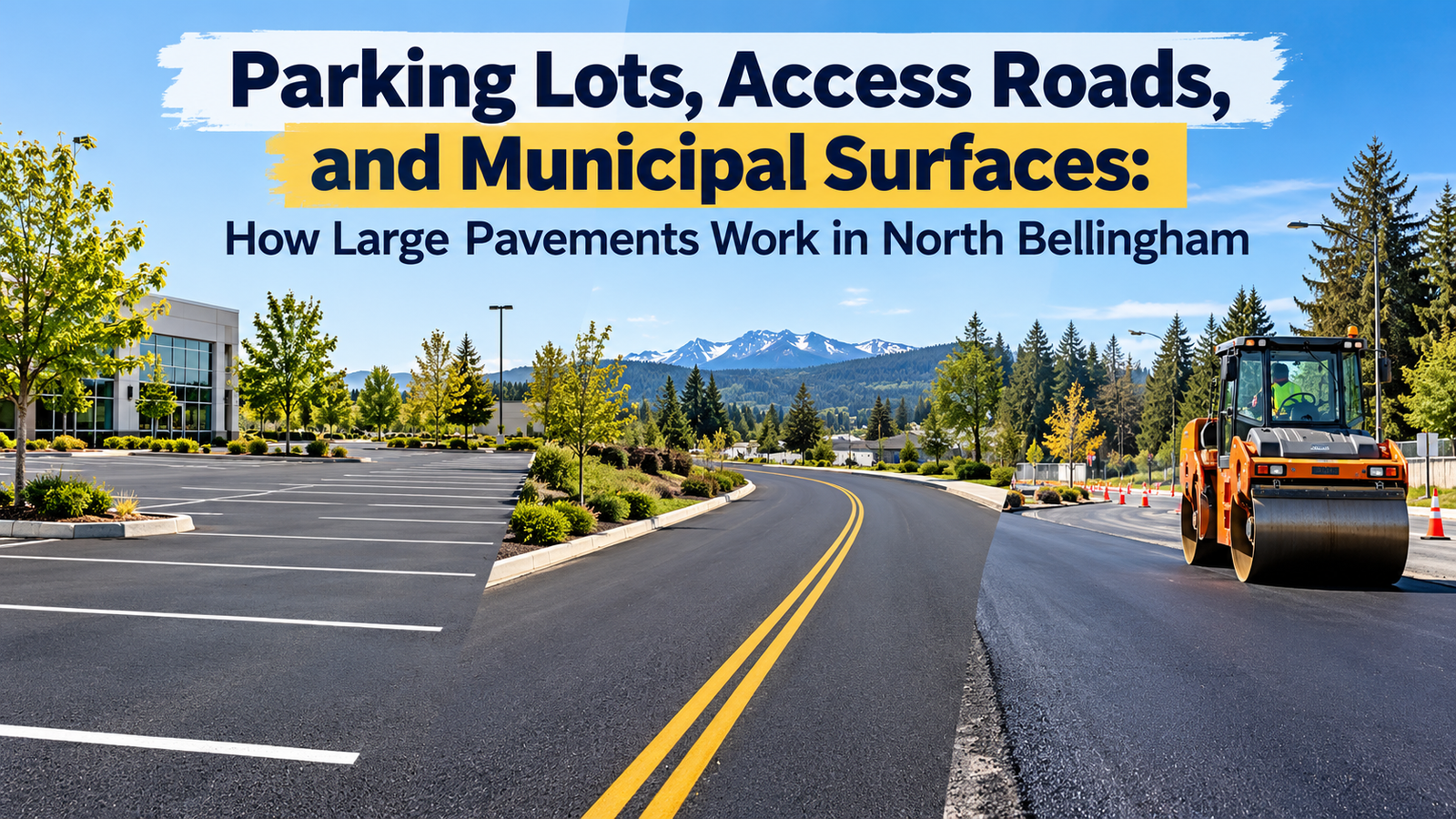
A driveway is a small pavement. A parking lot at a shopping plaza, a school access road, a church lot, or the apron in front of a light industrial building is a very different problem. The areas are larger, the loads are heavier and more varied, the safety and accessibility rules are more detailed, and drainage has to be handled at a scale that involves stormwater regulations. Many people encounter large pavements every day without ever thinking about how they are designed, striped, drained, and maintained.
This guide looks at the subject of commercial and municipal Paving contractor North Bellingham in general terms, using North Bellingham, Massachusetts as the setting. North Bellingham sits in Norfolk County near the Franklin and Wrentham lines, close to Interstate 495 and Route 126, in a part of the state that mixes older village streets, commercial corridors, light industry, and residential neighborhoods. The article explains how large pavements are structured, how traffic and drainage shape their design, what accessibility and striping involve, and how lots are maintained over their life. It is general background, not a design for any specific site.
Why Large Pavements Are Different
Several differences separate a parking lot from a residential driveway.
Scale. Large areas multiply the consequences of every decision. A small error in grade that would be invisible in a driveway can cause ponding across thousands of square feet.
Load variety. A lot may see passenger cars all day and a delivery truck, trash hauler, or fire apparatus occasionally. Those heavy but infrequent loads often govern the pavement design.
Turning and stopping patterns. Entrances, drive aisles, dumpster pads, and loading zones concentrate stress in specific places.
Regulatory layers. Stormwater, accessibility, fire access, and zoning requirements all apply to a degree that is rare for homes.
Public use. Customers, students, patients, and employees expect a safe and legible surface, so surface defects carry safety implications beyond appearance.
The Structure of a Heavy Duty Pavement
A commercial pavement is built from the same basic layers as a driveway, but the thicknesses and materials are chosen for heavier traffic.
Subgrade preparation. The native soil is stripped of organic material, evaluated, and compacted. Soft or unstable zones may be undercut and replaced, or stabilized with geotextile fabric or other methods.
Aggregate base. Crushed stone is placed in layers, often several inches thick or more, and compacted. This is the load spreading foundation of the pavement.
Asphalt layers. Heavy duty pavements usually include a structural base or binder course beneath a surface course. The total thickness depends on expected traffic. Truck routes and loading areas generally receive more thickness than parking stalls.
Edge restraint. Curbing, whether granite, precast, or bituminous, provides lateral support and directs stormwater.
The concept of equivalent single axle loads, abbreviated ESAL, is used in pavement design to express the cumulative damage that different vehicles inflict. A loaded truck can do thousands of times the damage of a passenger car per pass. That is why a few trucks a day can matter more than hundreds of cars.
Traffic Zones Within a Single Lot
Careful designers think of a lot as several zones rather than one uniform surface.
Parking stalls. Cars park and leave with low speed movements. Loads are light, but vehicles may sit in the same spot for long periods, and fluids can drip.
Drive aisles. These carry moving traffic, including occasional heavy vehicles.
Entrances and exits. Heavy turning, braking, and acceleration happen here, and trucks turning in and out put the greatest stress on the surface.
Loading docks and dumpster pads. These areas experience repetitive heavy loads and slow, tight turns. Many are built of concrete, because asphalt can rut under static heavy loads in summer heat.
Fire lanes and emergency access. Fire apparatus is heavy, and access routes must support it.
Pedestrian crossings and walkways. Surfaces must be smooth, accessible, and clearly marked.
Stormwater and Drainage at Scale
Impervious pavement sheds water quickly, producing runoff that must be managed. In Massachusetts, stormwater is regulated under state and local rules, and larger projects typically need to address both quantity and quality of runoff. The concepts are common to many regions.
Catch basins and drainage structures. Inlets collect runoff and carry it to pipes or other treatment structures. Many include sumps that trap sediment.
Detention and retention. Basins temporarily hold runoff to reduce peak flow downstream.
Infiltration. Some systems allow water to soak into the ground, which is more feasible in sandy soils than in dense till.
Swales and vegetated buffers. Planted channels slow and filter runoff.
Oil and grit separators. These structures capture hydrocarbons and sediment before water leaves a site.
Grading. Slopes are set so water moves toward inlets without ponding. Typical design targets for paved slopes are modest, often in the range of one to five percent, with minimums to avoid standing water.
Bellingham, like many towns in the Charles and Blackstone watersheds, includes streams, wetlands, and floodplain areas, and development near them generally involves review by local boards and conservation authorities. Anyone studying a particular site would check current local requirements.
Accessibility Requirements
Public and commercial lots are subject to accessibility standards under the Americans with Disabilities Act and Massachusetts rules administered by the Architectural Access Board. While details vary by project, the general principles include the following.
- A required number of accessible parking spaces based on total spaces.
- Minimum widths for spaces and adjacent access aisles.
- Van accessible spaces with extra clearance.
- Limits on slope within accessible spaces and aisles, commonly no more than about two percent in any direction.
- Accessible routes connecting parking to building entrances.
- Curb ramps with detectable warning surfaces.
- Required signage at specific heights.
These requirements affect pavement design directly, since slopes and cross grades must be controlled tightly in the areas where they apply. Re-striping or repaving can trigger accessibility review in some situations.
Striping and Markings
Pavement markings communicate rules without words. The layout includes more than parking lines.
Stall lines. Dimensions and angles influence how efficiently a lot works. Ninety degree parking typically maximizes capacity, while angled parking eases one way circulation.
Directional arrows. These guide traffic through aisles and entrances.
Crosswalks and stop bars. Placed at pedestrian crossings and exits.
Fire lane markings. These are often required in red or yellow and must remain visible.
Accessible symbols and aisles. Shown in specific colors and patterns.
Material. Most striping uses traffic paint, though thermoplastic and epoxy options last longer in high wear areas. Paint adheres best to clean, dry, and fully cured surfaces.
Markings fade with traffic, sun, plows, and chemicals, which is why restriping is a regular part of lot maintenance.
Pavement Condition and the Life Cycle
Pavement engineers describe the life of a surface as a curve. Condition declines slowly at first, then more quickly as damage accelerates. Maintenance applied early in the curve is generally less disruptive than rebuilding later. Common treatments include the following.
Crack sealing. Keeps water out of the structure.
Surface treatments. Sealcoating or similar products can slow oxidation on lots in good structural condition.
Mill and overlay. The top layer is ground off and replaced. This resets the surface while keeping the base.
Full depth reclamation. The existing pavement and base are pulverized, mixed, and recompacted into a new foundation.
Reconstruction. Everything is removed and rebuilt.
Many property managers and municipalities use pavement condition indexes, commonly scored from zero to one hundred, to track networks and plan work. These scores inform which streets or lots to treat in a given season.
Municipal Pavements and Public Roads
Town roads follow similar principles, with additional layers of public process. Municipal pavement programs usually involve the following.
- Inventory and rating of roads by condition.
- Prioritization based on traffic, safety, and funding availability.
- Coordination with utility work so that new pavement is not cut open soon after placement.
- State funding programs such as Chapter 90 in Massachusetts, which provides aid to municipalities for road work.
- Public bidding and specifications for larger projects.
- Seasonal scheduling that follows the New England paving window.
Utility trenches are a notable factor. Gas, water, sewer, and telecommunications work often requires cutting pavement, and poorly restored trench patches can become long term weak points.
Heavy Equipment and Placement Concepts
Commercial paving uses larger equipment than most people expect.
Milling machines. These grind away existing asphalt to a set depth, producing reclaimed material that can be reused.
Pavers. A tracked or wheeled machine receives hot mix from trucks and lays it at a controlled thickness and slope.
Rollers. Steel drum and rubber tire rollers compact the mat in a planned pattern. Density is a key quality measure.
Material transfer vehicles. These remix and deliver asphalt to the paver, which helps keep temperature uniform.
Smoothness and density are the main measures of finished quality. Joints between passes of the paver are carefully constructed because poorly made joints are common failure points.
Seasonal and Site Conditions in North Bellingham
North Bellingham’s setting influences how paving is approached.
Commercial corridors. Routes such as Route 126 and nearby roads carry mixed traffic including trucks, which raises the importance of strong pavement sections at entrances.
Proximity to Interstate 495. Regional traffic and freight activity influence nearby commercial and industrial sites.
Freeze and thaw. Like the rest of eastern Massachusetts, the area sees many freeze and thaw cycles, with associated cracking and pothole formation.
Plowing and salting. Commercial lots are plowed often, and deicers are heavily used. Salt storage and drainage are items of environmental concern near wetlands and water supplies.
Mixed land uses. Older village areas, newer plazas, and light industrial parks coexist, so pavements range in age and condition.
Local review. Site plan review by town boards typically addresses drainage, access, parking counts, lighting, and landscaping.
Safety During Paving Operations
Large paving projects involve moving equipment, hot material, and public access.
- Traffic control plans guide vehicles around work zones.
- Pedestrian routes are protected or relocated.
- Hot mix is handled at high temperatures, which calls for protective gear.
- Dust, fumes, and noise are managed according to the setting.
- Businesses often coordinate phased work so parts of a lot remain open.
Phasing, which divides a lot into sections, keeps entrances and accessible spaces available during construction and is a common planning technique.
Common Misunderstandings
“Parking lots are just bigger driveways.” Load, drainage, and regulatory requirements differ substantially.
“If the surface looks fine, the pavement is fine.” Base problems can be hidden until the surface fails.
“Striping is purely cosmetic.” Markings communicate safety and accessibility information and may be required.
“Overlays solve every problem.” Overlays work when the structure is sound. Weak bases and drainage issues remain after one.
“Stormwater is someone else’s concern.” Runoff from a lot becomes part of the larger watershed.
Frequently Asked Questions
What is the difference between a commercial and residential paving project?
Commercial projects involve greater area, heavier loads, more detailed drainage, and additional regulatory requirements such as accessibility and stormwater management.
How thick is a typical commercial asphalt pavement?
It varies with traffic and soils. Light duty parking areas are thinner than truck routes, and designers set thickness based on expected loading and base conditions.
What is mill and overlay?
A process in which the top layer of an asphalt pavement is ground off and replaced with new material, restoring the surface without rebuilding the whole structure.
Why do loading areas often use concrete?
Concrete resists the rutting that heavy, stationary loads can cause in asphalt, especially in warm weather.
How often should parking lot markings be refreshed?
It depends on traffic, climate, and the paint used. High traffic areas fade faster, and many properties refresh markings every few years.
What are ADA parking requirements?
They set minimum numbers of accessible spaces, dimensions, slopes, signage, and routes. The exact counts depend on the total number of spaces and the type of facility.
What is a catch basin?
A drainage structure that collects stormwater from pavement, often with a sump that traps sediment before the water continues into pipes.
Why is compaction so important?
Dense pavement resists water entry and deformation. Poorly compacted asphalt tends to ravel, rut, and crack early.
Final Thoughts
Large pavements combine civil engineering, regulation, and maintenance planning. They are designed around the heaviest loads they will carry, drained according to stormwater rules, marked to guide and protect users, and maintained along a life cycle that rewards early attention.
For readers interested in how a paving contractor in North Bellingham fits into the commercial and municipal landscape of this part of Norfolk County, the key point is that every lot is a system. Base, surface, drainage, accessibility, and markings all interact, and understanding that interaction is the best way to make sense of the field.